
Availability

System Design Interview - Chapter 8 - Design a URL Shortener

System Design Interview - Chapter 8 - Design a URL Shortener

Translations: RU

The previous chapters have described the underlying technologies such as consistent hashing, ID generator, and now using these techniques we can develop a URL shortener that can generate 100 million URLs per day.

Design consists of the following elements:

  • API endpoints
  • URL redirecting
  • URL shortening
  • Data model
  • Hash functions: Hash + collision resolution vs Base-62 conversion
  • Additional topics to consider:
    • Rate limiter
    • Web server scaling
    • Database scaling
    • Analytics
    • Availability, consistency, and reliability

These items are disclosed in a very interesting Chapter 8 of the book:

System Design Interview - Chapter 2 - Back-to-the-envelope estimation

System Design Interview - Chapter 2 - Back-to-the-envelope estimation

Translations: RU

A very short Chapter 2 is about how to make rough estimates to start from the most important parts when designing the software.

Some concepts that EVERY software developer should know:

  • “Power of two”
  • Standard latency numbers! How fast is memory, how slow is disk, etc…
  • Availability numbers
  • What are key metrics you should think about

These concepts and numbers are disclosed in chapter two of the book:

“System Design Interview – An insider’s guide” by Alex Xu

Designing Data-Intensive Applications - Chapter 9 - Consistency and Consensus

Designing Data-Intensive Applications - Chapter 9 - Consistency and Consensus

Translations: RU

Earlier the book club of our company has studied excellent book:

Martin Kleppmann - Designing Data-Intensive Applications

This is the best book I have read about building complex scalable software systems. 💪

As usually I prepared an overview and mind-map.

Chapter 9 tells about Consistency and Consensus in distributed systems. It covers the following topics:

  • What is consistency and eventual consistency
  • Linearizability. Why it is needed. Difference from Serializability. How to implement Linearizability. The cost of Linearizability. CAP theorem.
  • Ordering Guarantees. What is ordering and causality. It’s relation to Linearizability. Sequence Number Ordering and how to implement it. Total Order Broadcast and how to implement it.
  • Distributed Transactions and Consensus. Why we need Consensus and Distributed Transactions. How to implement them, related problems and software that helps.

Summary:

Designing Data-Intensive Applications - Chapter 5 - Replication

Designing Data-Intensive Applications - Chapter 5 - Replication

Translations: RU

Earlier the book club of our company has studied excellent book:

Martin Kleppmann - Designing Data-Intensive Applications

This is the best book I have read about building complex scalable software systems. 💪

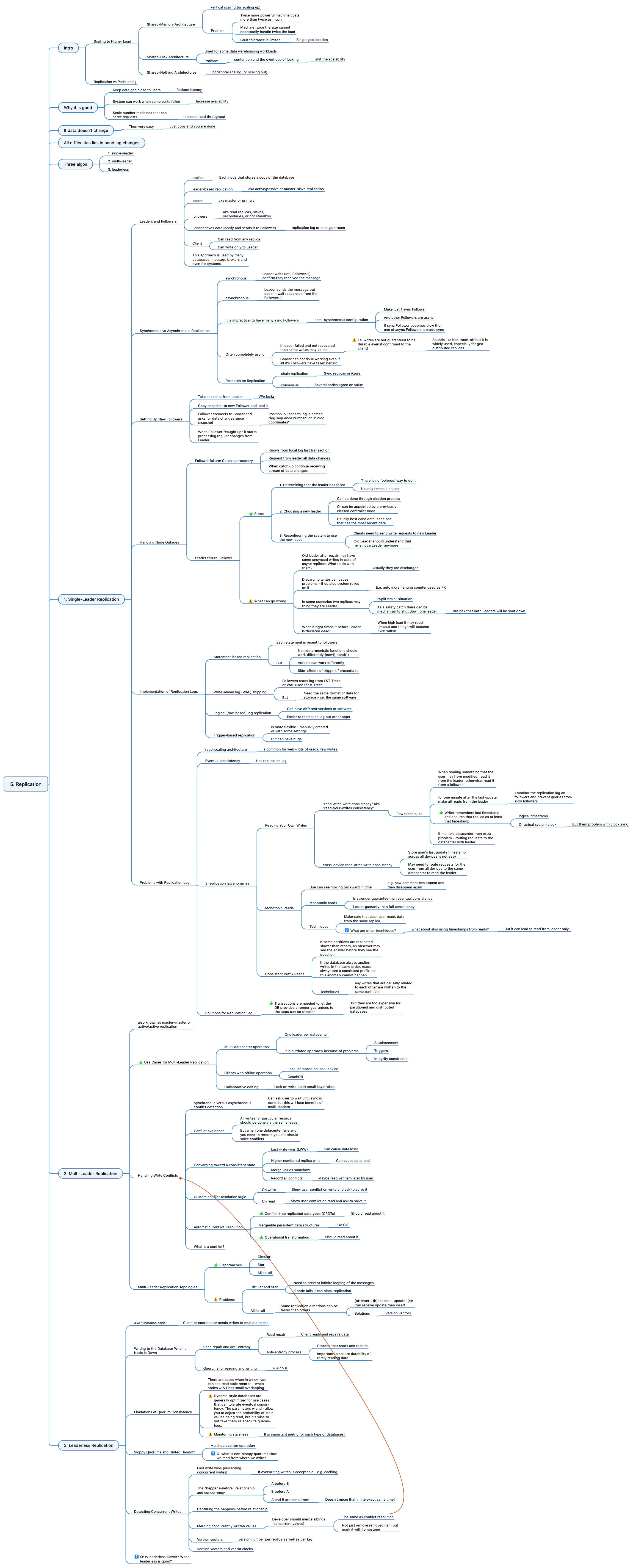
As usually I prepared an overview and mind-map.

Chapter 5:

  • Intro. How to scale apps. Replicating and partitioning.
  • Three algos of replicating
  • Single-leader Replication
    • Leaders and Followers
    • Sync and async replication
    • Adding new Followers
    • Handling node outages
    • Technical implementations and all potential problems
  • Multi-Leader Replication
    • Use-cases when it is good
    • Handling write conflicts
    • Three topologies and potential problems
  • Leaderless Replication
    • Writing to the database when a node is down
    • Quorums and problems with them
    • Detecting concurrent writes and how to resolve them

Download full mind map (PDF)