SQL

Building Event-Driven Microservices - Chapter 12 - Lightweight Framework Microservices

Building Event-Driven Microservices - Chapter 12 - Lightweight Framework Microservices

Translations: RU

The 4th pattern to build microservices is to use Lightweight Frameworks.

Lightweight Frameworks provide similar functionality to Heavyweight Frameworks, but they heavily rely on:

  • the event broker
  • the container management system (CMS)

In many cases they exceed Heavyweight Frameworks.

Different apps can use any/different resources from the cluster which are better fit their needs. While still provide Scaling and Recovering from Failures (again by heavily relying on event broker and CMS).
Building Event-Driven Microservices - Chapter 11 - Heavyweight Framework Microservices

Building Event-Driven Microservices - Chapter 11 - Heavyweight Framework Microservices

Translations: RU

Heavyweight Stream Processing Frameworks are another foundation/pattern to build your microservices.

These frameworks are highly scalable and allow you to efficiently solve many analytical tasks. But they are not always good for stateful event-driven microservice application patterns.

Heavyweight frameworks operate using centralized resource clusters, which may require additional operational overhead, monitoring, and coordination to integrate successfully into a microservice framework. However, recent innovations move these frameworks toward container management solutions (CMS) such as Kubernetes that should reduce your efforts.

Designing Data-Intensive Applications - Chapter 2 - Data Models and Query Languages

Designing Data-Intensive Applications - Chapter 2 - Data Models and Query Languages

Translations: RU

Earlier this year the book club of our company has studied excellent book:

Martin Kleppmann - Designing Data-Intensive Applications

This is the best book I have read about building complex scalable software systems. 💪

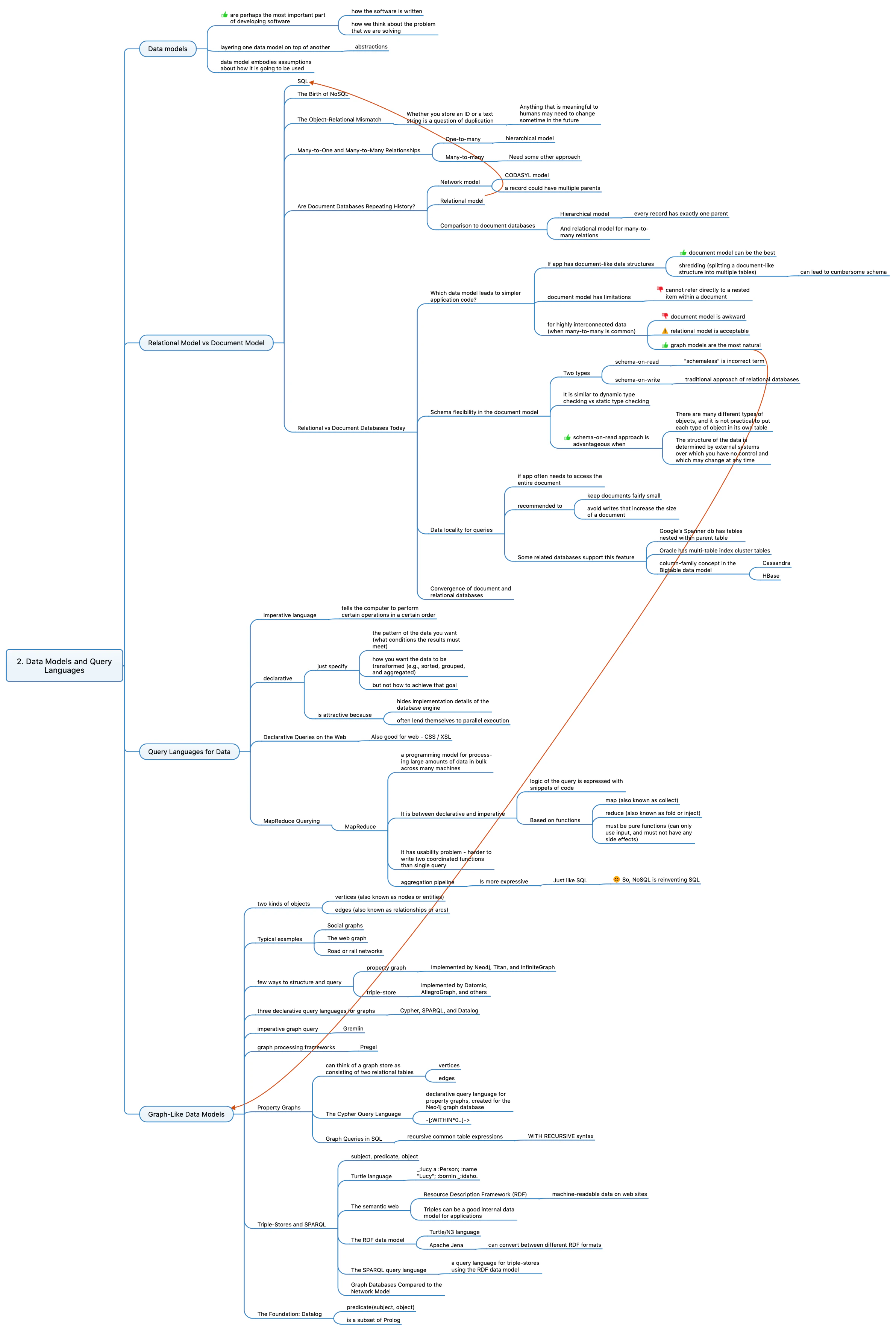
As usually I prepared an overview and mind-map.

Chapter 2:

  • What is data model.
  • Different relations between the data.
  • Relational, Document, Graph data models. Which one is better and when.
  • Schema-on-write, schema-on-read (schemaless). Data locality.
  • Query languages: imperative, declarative, MapReduce. Why NoSQL is reinventing SQL 😀
  • Storing graphs. Query languages for graphs: Cypher, SPARQL, Datalog.

Download full mind map (PDF)