Database

System Design Interview - Chapter 6 - Design a Key-Value store

System Design Interview - Chapter 6 - Design a Key-Value store

Translations: RU

Key-Value stores are the most basic but widely used data storages.

Design of key-value store consists of understanding the following topics:

  • What do we want from key-value store?
  • Single server key-value store
  • DISTRIBUTED key-value store:
    • CAP theorem
    • Real-world trade-offs for distributed systems
  • System components:
    • Data partition
    • Data replication
    • Consistency
    • Inconsistency resolution: Versioning
    • Handling all types of failures: Failure detection, Handling TEMPORARY failures, Handling PERMANENT failures, Handling data center outage
  • System architecture diagram
  • Write path
  • Read path

These items are disclosed in a very interesting Chapter 6 of the book:
System Design Interview - Chapter 5 - Design Consistent Hashing

System Design Interview - Chapter 5 - Design Consistent Hashing

Translations: RU

Consistent Hashing is a cornerstone technology for distributed systems. Many of software developers don’t realize it, but Consistent Hashing is needed in many places: load balancers, caches, CDNs, id generators, databases, chats / social networks, and many other systems.

This topic consists of:

  • Problem with rehashing and why we need hashing to be CONSISTENT
  • Hash space and hash ring
  • BASIC approach (introduced by Karger et al. at MIT)
  • Advanced approach with VIRTUAL NODES

These items are disclosed in a very interesting Chapter 5 of the book:

System Design Interview - Chapter 3 - A Framework for System Design Interviews

System Design Interview - Chapter 3 - A Framework for System Design Interviews

Translations: RU

Four standard steps for system design interview. However, I would think about them wider: as about four initial steps to design the software.

  • Step 1. Understand the problem and establish design scope
  • Step 2. Propose high-level design and get buy-in
  • Step 3. Design deep dive
  • Step 4. Wrap up

The chapter 3 of the book discovers details about each step, good questions to ask (to think about), DO’s and DONT’s. It also shows good example of the process of designing a news feed system.

System Design Interview - Chapter 1 - Scale from zero to millions of users

System Design Interview - Chapter 1 - Scale from zero to millions of users

Translations: RU

A great generic plan for scaling any app from zero to millions of users.

  • Single server setup
  • Selection and usage of database
  • Vertical scaling vs horizontal scaling approaches. And why you should prefer horizontal
  • Adding load balancer for horizontal scaling
  • Adding database replication for horizontal scaling
  • Adding cache
  • Adding CDN
  • Stateless vs Stateful architecture and using external state storage
  • Adding extra Data Centers
  • Adding Message queue
  • Adding Logging, Metrics, and Automation
  • Scaling database (sharding)
  • and futher steps…

All of these is carefully but briefly disclosed in the Chapter 1 of the book:

Clean Architecture - PART VI - Details

Clean Architecture - PART VI - Details

Translations: RU

The book club of our company has chosen a new wonderful book for reading:

Robert Martin - Clean Architecture - a Craftsman’s Guide to Software Structure and Design

👍

The part VI undermines some foundations 😀:

  • Do you know that Database is a “detail”? An unimportant minor low-level non-essential feature that can be neglected in architecture design!
  • Do you know the same about the Web? It is just an unimportant IO device that should also be neglected in architecture design!
  • What about Frameworks? The same. Don’t marry your framework. Use safe and better remote sex. 🤣
  • There are several examples of how similar architectures may or may not lead to problems. And what to use to avoid problems (spoiler: Encapsulation)
  • All of the above, and a brief missing advice…

Great information! All the details are in my mind maps:

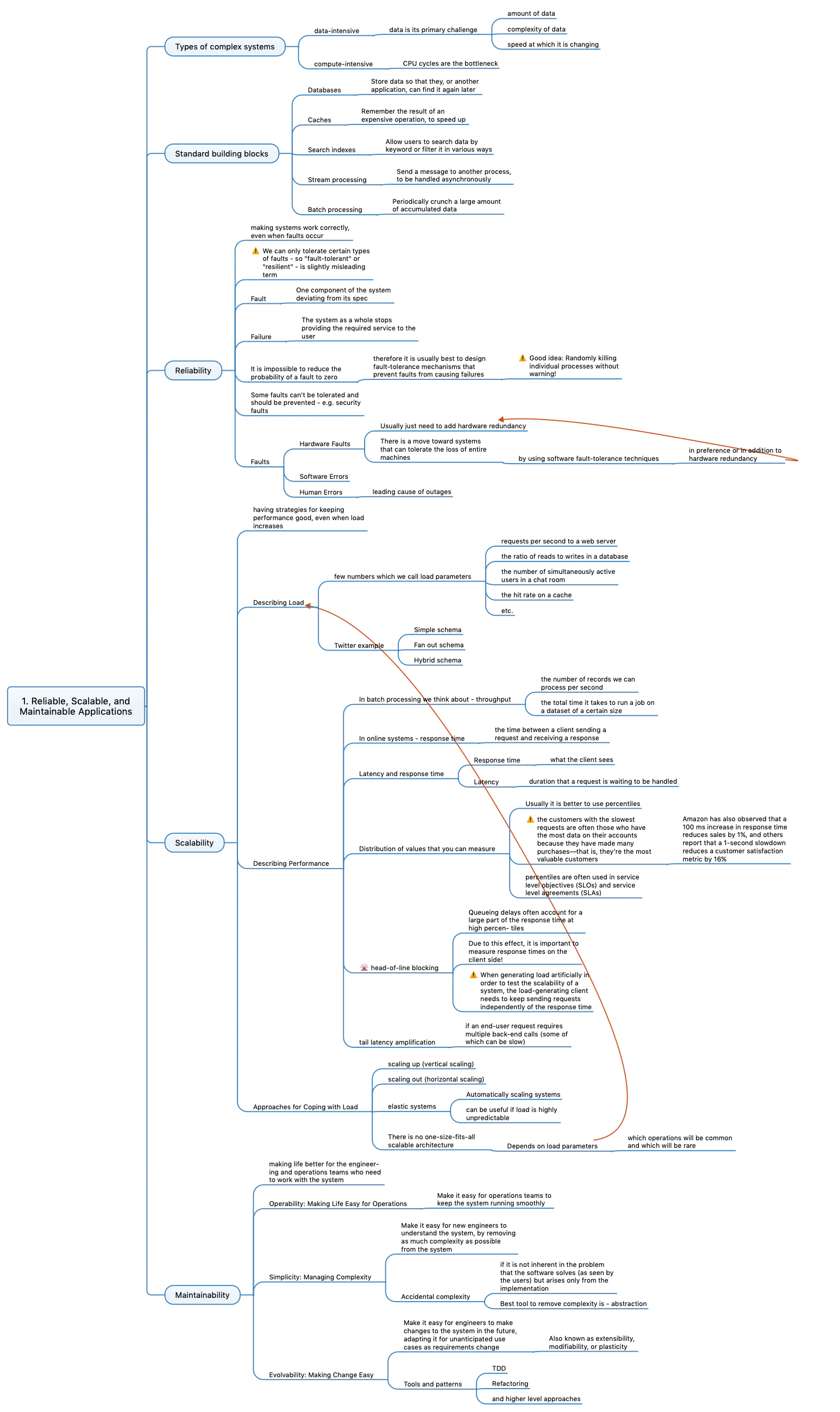
Designing Data-Intensive Applications - Chapter 1 - Reliable, Scalable, and Maintainable Applications

Designing Data-Intensive Applications - Chapter 1 - Reliable, Scalable, and Maintainable Applications

Translations: RU

Earlier this year the book club of our company has studied excellent book:

Martin Kleppmann - Designing Data-Intensive Applications

This is the best book I have read about building complex scalable software systems. 💪

As usually (to better learn) I prepared an overview and mind-map.

Chapter 1:

  • Building blocks of the apps
  • What is Reliability, Scalability and Maintainability. Examples and definitions.
    • Faults and Failures
    • Performance, Load, Latency and Response Time
    • Operability, Simplicity, Evolvability
  • Why you should randomly kill your servers 😅
  • How Twitter delivers 12,000 tweets per second to 300,000 readers per second. (VERY interesting!)
  • How much money Amazon loses for each 100ms delay in their response time
  • How to quickly calculate percentiles for monitoring response time in PROD

Download full mind map (PDF)