
Load Balancer

System Design Interview - Chapter 5 - Design Consistent Hashing

System Design Interview - Chapter 5 - Design Consistent Hashing

Translations: RU

Consistent Hashing is a cornerstone technology for distributed systems. Many of software developers don’t realize it, but Consistent Hashing is needed in many places: load balancers, caches, CDNs, id generators, databases, chats / social networks, and many other systems.

This topic consists of:

  • Problem with rehashing and why we need hashing to be CONSISTENT
  • Hash space and hash ring
  • BASIC approach (introduced by Karger et al. at MIT)
  • Advanced approach with VIRTUAL NODES

These items are disclosed in a very interesting Chapter 5 of the book:

System Design Interview - Chapter 3 - A Framework for System Design Interviews

System Design Interview - Chapter 3 - A Framework for System Design Interviews

Translations: RU

Four standard steps for system design interview. However, I would think about them wider: as about four initial steps to design the software.

  • Step 1. Understand the problem and establish design scope
  • Step 2. Propose high-level design and get buy-in
  • Step 3. Design deep dive
  • Step 4. Wrap up

The chapter 3 of the book discovers details about each step, good questions to ask (to think about), DO’s and DONT’s. It also shows good example of the process of designing a news feed system.

System Design Interview - Chapter 1 - Scale from zero to millions of users

System Design Interview - Chapter 1 - Scale from zero to millions of users

Translations: RU

A great generic plan for scaling any app from zero to millions of users.

  • Single server setup
  • Selection and usage of database
  • Vertical scaling vs horizontal scaling approaches. And why you should prefer horizontal
  • Adding load balancer for horizontal scaling
  • Adding database replication for horizontal scaling
  • Adding cache
  • Adding CDN
  • Stateless vs Stateful architecture and using external state storage
  • Adding extra Data Centers
  • Adding Message queue
  • Adding Logging, Metrics, and Automation
  • Scaling database (sharding)
  • and futher steps…

All of these is carefully but briefly disclosed in the Chapter 1 of the book:

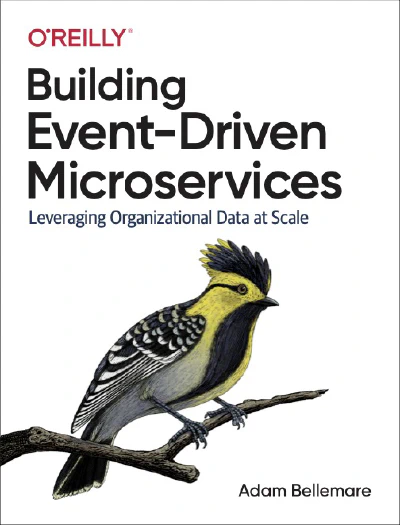
Building Event-Driven Microservices - Chapter 13 - Integrating Event-Driven and Request-Response Microservices

Building Event-Driven Microservices - Chapter 13 - Integrating Event-Driven and Request-Response Microservices

Translations: RU

How to integrate event-driven microservices with request-response APIs?

There are two types of external events:

  • Autonomously Generated Events (analytical events)
  • Reactively Generated Events (events from request-reply)

There are two approaches of processing and serving requests using stateful services:

  • using internal state stores (with silly or with smart routing)
  • using external state stores (with regular or with composite microservice)

Ways of handling requests within an event-driven workflow:

  • Handling requests directly
  • Turning requests into events (big latency)
  • Processing events for user interfaces (a mix of two ways)

Approaches for request-response applications, their pros and cons:

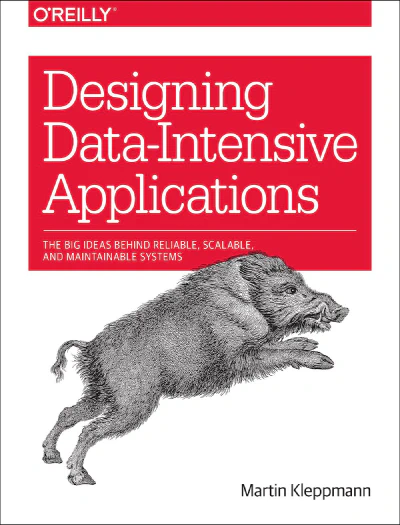
Designing Data-Intensive Applications - Chapter 6 - Partitioning

Designing Data-Intensive Applications - Chapter 6 - Partitioning

Translations: RU

Earlier the book club of our company has studied excellent book:

Martin Kleppmann - Designing Data-Intensive Applications

This is the best book I have read about building complex scalable software systems. 💪

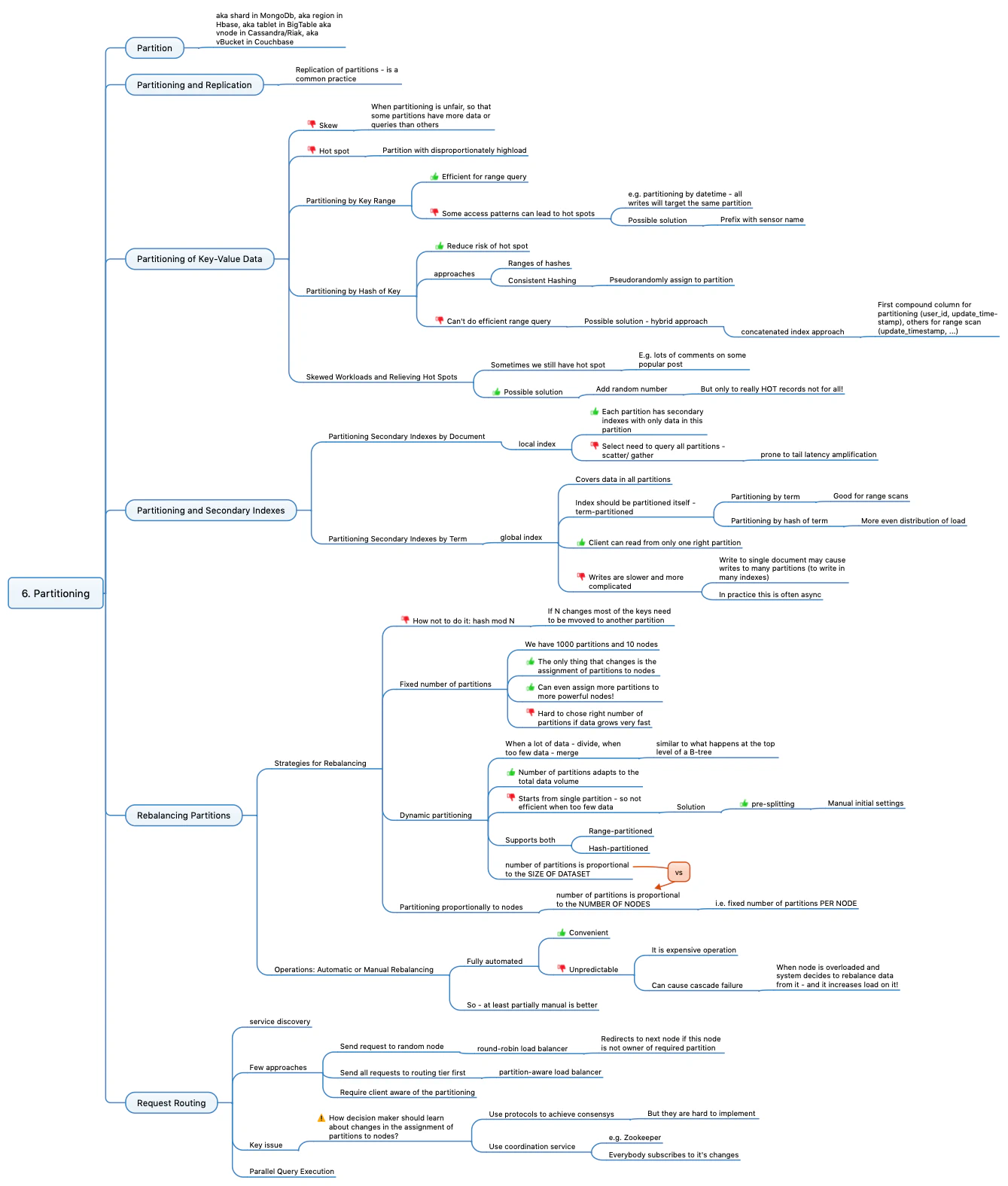
As usually I prepared an overview and mind-map.

Chapter 6 contains everything the DEV team should consider when designing storage for big data:

  • Partition aka Shard aka Region aka Tablet aka vNode aka vBucket. It is another approach for storing the data in addition to Replication (reviewed in the previous chapter)
  • How to partition key-value data (primary index). Problems with partitioning - skew and hotspot. Approaches: key range and hash of key.
  • Partitioning for secondary indexes: Local index and Global index
  • Rebalancing partitions as you grow. Bad and good aproaches, problems and how to deal with them. Manual vs automated rebalancing.
  • Request routing. Different aproaches, issues and solutions.

Download full mind map (PDF)