Management and Efficiency

Justice - 05 - Markets and Morals

Justice - 05 - Markets and Morals

Translations: RU

In the next two lections of JUSTICE you dive into the intriguing debates on military conscription, personal choice, and patriotism. Then explore the ethical dilemmas of surrogacy, consent, and commodification in the riveting. Uncover the limits of government power and the complexities of reproductive technology in these captivating discussions.

I am sharing my mind-map from the lectures as usual:

Download full mind map (PDF)

Summary of the lectures:

Justice - 04 - John Locke

Justice - 04 - John Locke

Translations: RU

Next two lectures uncover the intricacies of John Locke’s theories on NATURAL RIGHTS and CONSENT. Quite an interesting turn in Philosophy of Justice. However, the problem with John Locke is that borders in his ideas are a bit fuzzy.

I am sharing my mind-map from the lectures as usual:
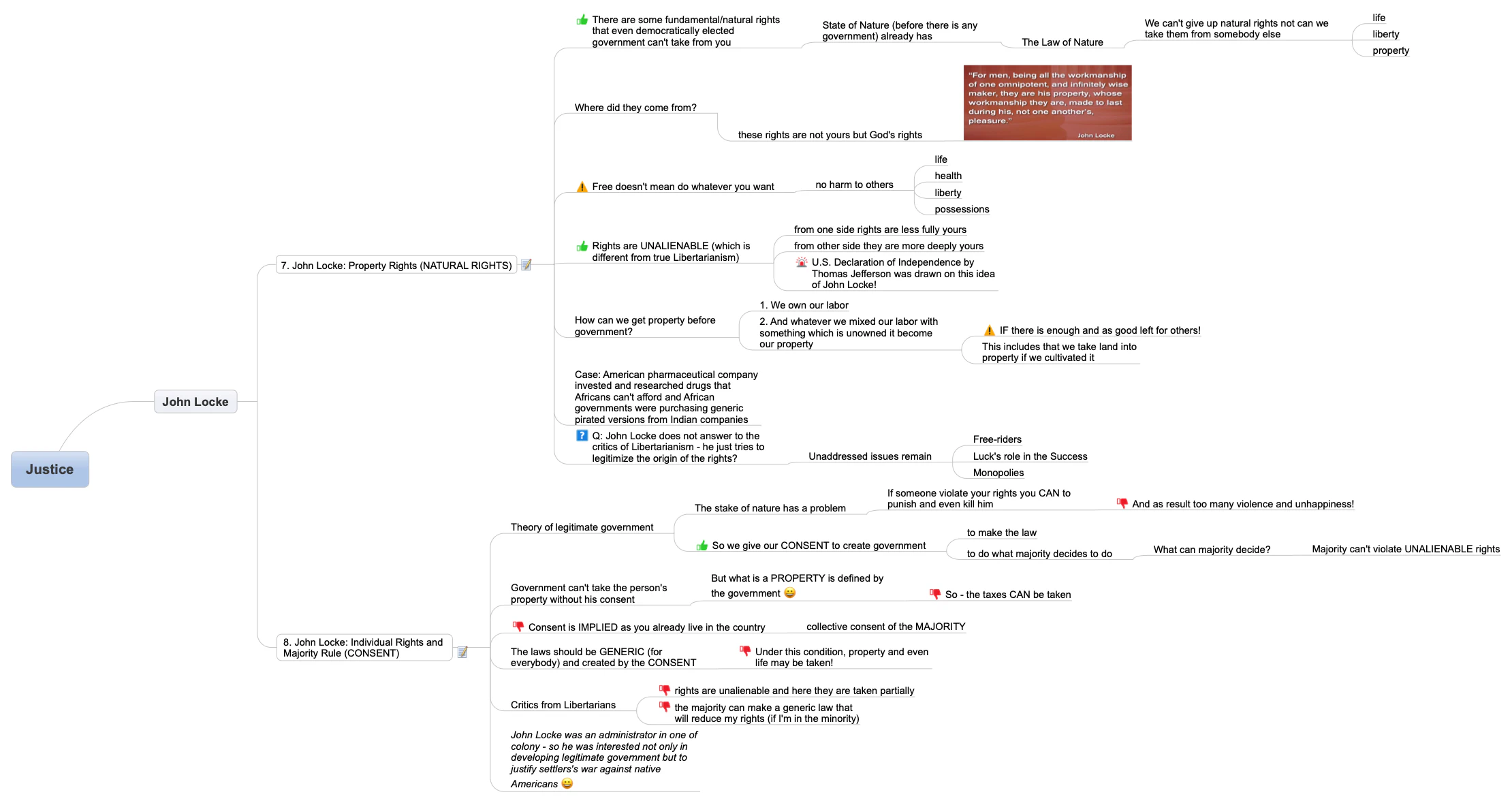
Download full mind map (PDF)

Summary of the lectures:

Lecture 7. John Locke: Property Rights (NATURAL RIGHTS)

In this lecture, the speaker discusses John Locke’s beliefs on individual rights, which include the natural rights to life, liberty, and property. Locke argues that these rights are inherent to individuals and that the state of nature, a state of liberty, has a law of nature that constrains individuals from violating each other’s natural rights. The lecture also emphasizes the importance of understanding how property fits into Locke’s theory of natural rights. The lecture then transitions to the issue of respecting patents and intellectual property rights in the context of the AIDS crisis in South Africa. The South African government started buying a generic version of the drug produced by an Indian company as the American AIDS drugs were too expensive for most Africans. The US government and pharmaceutical companies sued the South African government, but eventually gave in. The lecture then presents a critique of Locke’s account of private property by Rochelle, who argues that it justifies European cultural norms and the appropriation of land from Native Americans during European settlement. Dan defends Locke, arguing that Locke’s definition of labor-based property rights could apply to Native Americans’ use of the land, even if they did not enclose it with fences. The lecture suggests that Locke’s account of private property remains a controversial topic.

Justice - 03 - Libertarianism

Justice - 03 - Libertarianism

Translations: RU

These “Justice” lectures are covering my favorite topic - Libertarianism.

If I need to define my political views in one word, it would be Libertarianism. HOWEVER, when I am talking with my Libertarian acquaintances, I can call myself a “Pro-states man.” ;-)

For me, it is very clear why Libertarianism is not so popular:

  • most of the people who promote it are fanatics
  • they try to see the world in “black and white” and close their eyes to fundamental problems.

Fundamental problems include:

Justice - 02 - Utilitarianism

Justice - 02 - Utilitarianism

Translations: RU

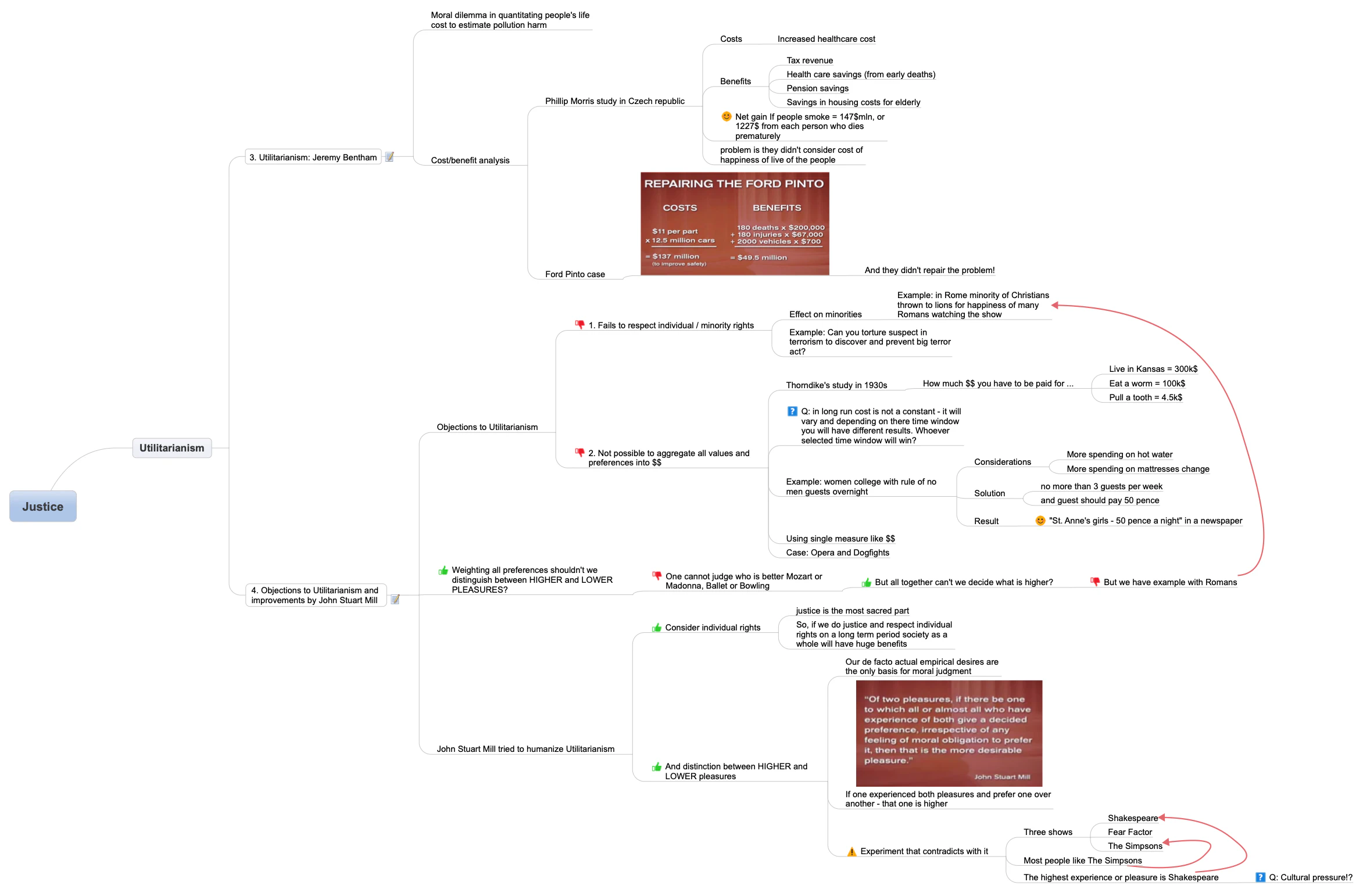
I continue overviewing lectures about Justice and sharing my mind-maps. This time I’m sharing my mind-map from the lectures on Utilitarianism.

Download full mind map (PDF)

Summary of the lectures:

Lecture 3: Utilitarianism - Jeremy Bentham

In this lecture, the speaker discusses Jeremy Bentham’s version of utilitarianism, which aims to maximize general welfare by balancing pleasure and pain, and the application of utilitarianism in cost-benefit analysis used by companies and governments. The lecture explores the example of a Philip Morris study on smoking in the Czech Republic, which found a net public finance gain of $147 million. The lecturer also discusses the Ford Pinto case, where Ford did a cost-benefit analysis to determine whether it was worth putting a special shield to protect the fuel tank and prevent it from exploding. The lecture also focuses on the contentious issue of putting a dollar value on human life in cost-benefit analysis, and the objections to utilitarianism, particularly the effect on minority groups and the trade-offs of individual rights for the greater good. The example of the shipwreck boy who was eaten is used to illustrate these objections.

Justice - 01 - Moral side of Murder

Justice - 01 - Moral side of Murder

Translations: RU

I have started a repeat of Harvard’s course Justice by Professor Michael J. Sandel. This course is about philosophy and discusses what is good and what is bad, and how these ideas have evolved over time. The course is especially important in today’s world as AI will soon be making decisions about WHO SHOULD LIVE AND WHO SHOULD DIE (being an IT specialist, I am interested in the patterns of falling into the first category, as you may guess ;-)

Thinking in Bets - Chapter 6 - Mental Time Travel

Thinking in Bets - Chapter 6 - Mental Time Travel

Translations: RU

Did you know that losing $1000 and then winning $900 (i.e. getting a result of -$100 in total) is more pleasant than winning $1000 and then losing $900 (i.e. getting a result of +$100 in total)!??

What has happened in the RECENT PAST drives our emotional response much more than how we are doing overall! It is a problem if you are making important prediction.

There are to ways to overcome this problem:

Thinking in Bets - Chapter 4 - The Buddy System

Thinking in Bets - Chapter 4 - The Buddy System

Translations: RU

People are not ready to consider themselves the source of the problem they are facing (their skill), they blame other people/circumstances (luck). How to overcome this issue?

One of the solution is to create “truth-seeking group” with your colleagues/friends/partners/“buddies”. And such a group should follow specific rules that would increase rationality…