Robert Martin

Clean Architecture - PART VI - Details

Clean Architecture - PART VI - Details

Translations: RU

The book club of our company has chosen a new wonderful book for reading:

Robert Martin - Clean Architecture - a Craftsman’s Guide to Software Structure and Design

👍

The part VI undermines some foundations 😀:

  • Do you know that Database is a “detail”? An unimportant minor low-level non-essential feature that can be neglected in architecture design!
  • Do you know the same about the Web? It is just an unimportant IO device that should also be neglected in architecture design!
  • What about Frameworks? The same. Don’t marry your framework. Use safe and better remote sex. 🤣
  • There are several examples of how similar architectures may or may not lead to problems. And what to use to avoid problems (spoiler: Encapsulation)
  • All of the above, and a brief missing advice…

Great information! All the details are in my mind maps:
Clean Architecture - PART V - Architecture

Clean Architecture - PART V - Architecture

Translations: RU

The book club of our company has chosen a new wonderful book for reading:

Robert Martin - Clean Architecture - a Craftsman’s Guide to Software Structure and Design

👍

Fifth part of the book contains A LOT of useful information:

What is software architecture? What type of interdependencies can exist? How to draw borderlines between components? What type of borders exist? How to distribute policies by the levels? What are business rules, entities and use cases? What architecture can and should “scream”? Description of Clean Architecture.

Clean Architecture - PART IV - Component Principles

Clean Architecture - PART IV - Component Principles

Translations: RU

The book club of our company has chosen a new wonderful book for reading:

Robert Martin - Clean Architecture - a Craftsman’s Guide to Software Structure and Design

Fourth part of the book is about principles of combining components into software systems.

This part is more interesting. It contains:

  • Overview of components history: Relocatability, Linkers
  • Three principles of Component Cohesion
    • REP: The Reuse/Release Equivalence Principle
    • CCP: The Common Closure Principle
    • CRP: The Common Reuse Principle
  • Three principles of Components Coupling
    • ADP: The Acyclic Dependencies Principle
    • SDP: The Stable Dependencies Principle
    • SAP: The Stable Abstractions Principle

I especially enjoyed this chapter because of presented metrics that could be used to measure(!) good software design (more precisely, how do you follow some design principles)

Clean Architecture - PART III - Design Principles

Clean Architecture - PART III - Design Principles

Translations: RU

The book club of our company has chosen a new wonderful book for reading:

Robert Martin - Clean Architecture - a Craftsman’s Guide to Software Structure and Design

👍

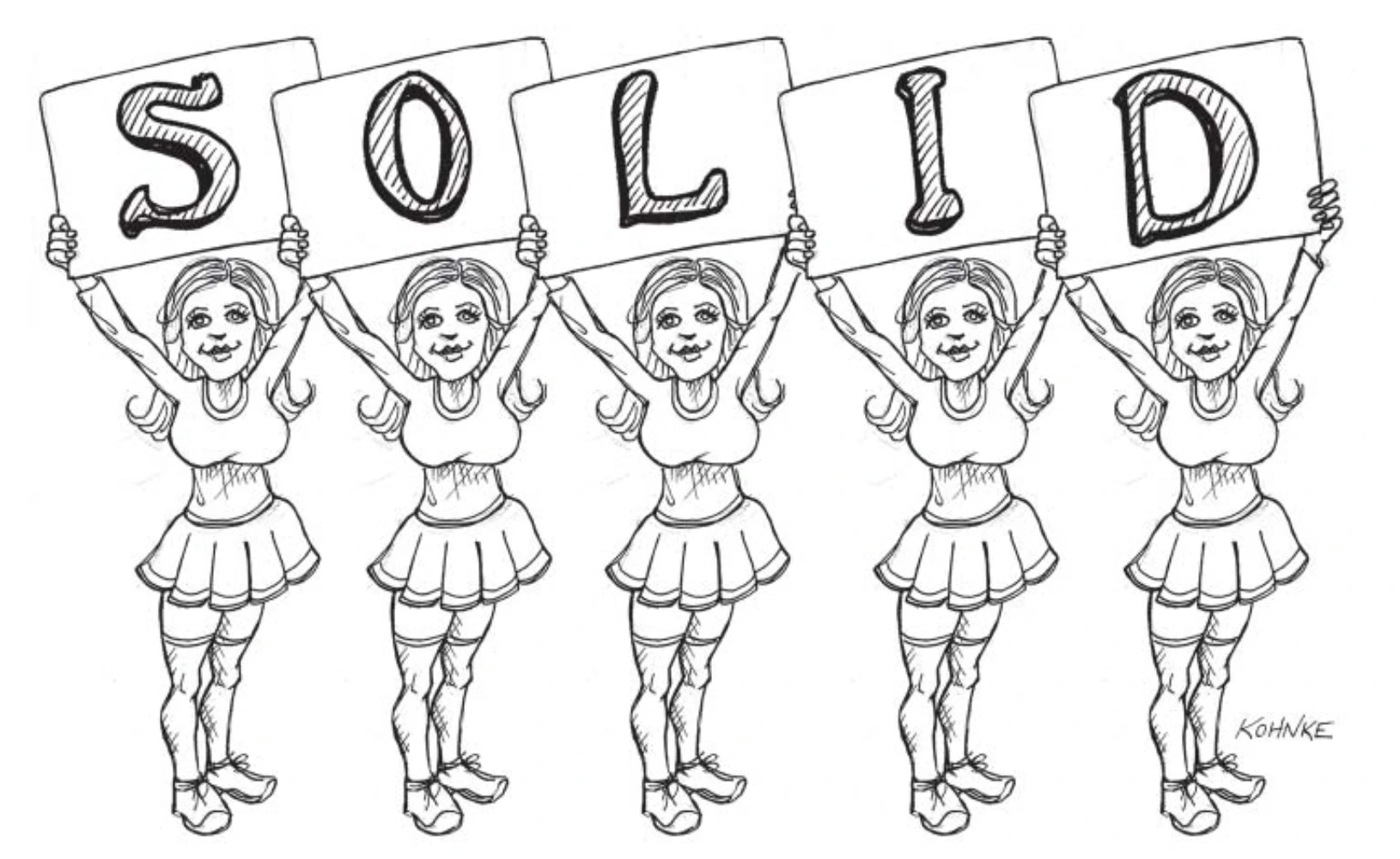
Third part of the book is about SOLID principles

SOLID
  • Single Responsibility Principle: A module should be responsible to one, and only one, actor.
  • Open-Closed Principle: A software artifact should be open for extension but closed for modification
  • Liskov Substitution Principle: S is a subtype of T if instead of instance of T we can always use an instance of S
  • Interface Segregation Principle: use interfaces to reduce dependency upon changes
  • Dependency Inversion Principle: avoid dependencies on volatile concrete elements

I didn’t learn anything new from here (but I am in software engineering for 20+ years already ;). However, this is still a good summarization of key design principles. And it’s worth to remember about them.

Clean Architecture - PART II - Starting with the Bricks: Programming Paradigms

Clean Architecture - PART II - Starting with the Bricks: Programming Paradigms

Translations: RU

The book club of our company has chosen a new wonderful book for reading:

Robert Martin - Clean Architecture - a Craftsman’s Guide to Software Structure and Design

👍

The book is superficial so far. Here’s an overview of the second part:

There are three programming paradigms:

  • Structured programming - is discipline imposed upon direct transfer of control.
  • Object-oriented programming - is discipline imposed upon indirect transfer of control.
  • Functional programming - is discipline imposed upon variable assignment

All three paradigms are about what NOT TO DO.

Clean Architecture - PART I - Introduction

Clean Architecture - PART I - Introduction

Translations: RU

The book club of our company has chosen a new wonderful book for reading:

Robert Martin - Clean Architecture - a Craftsman’s Guide to Software Structure and Design

👍

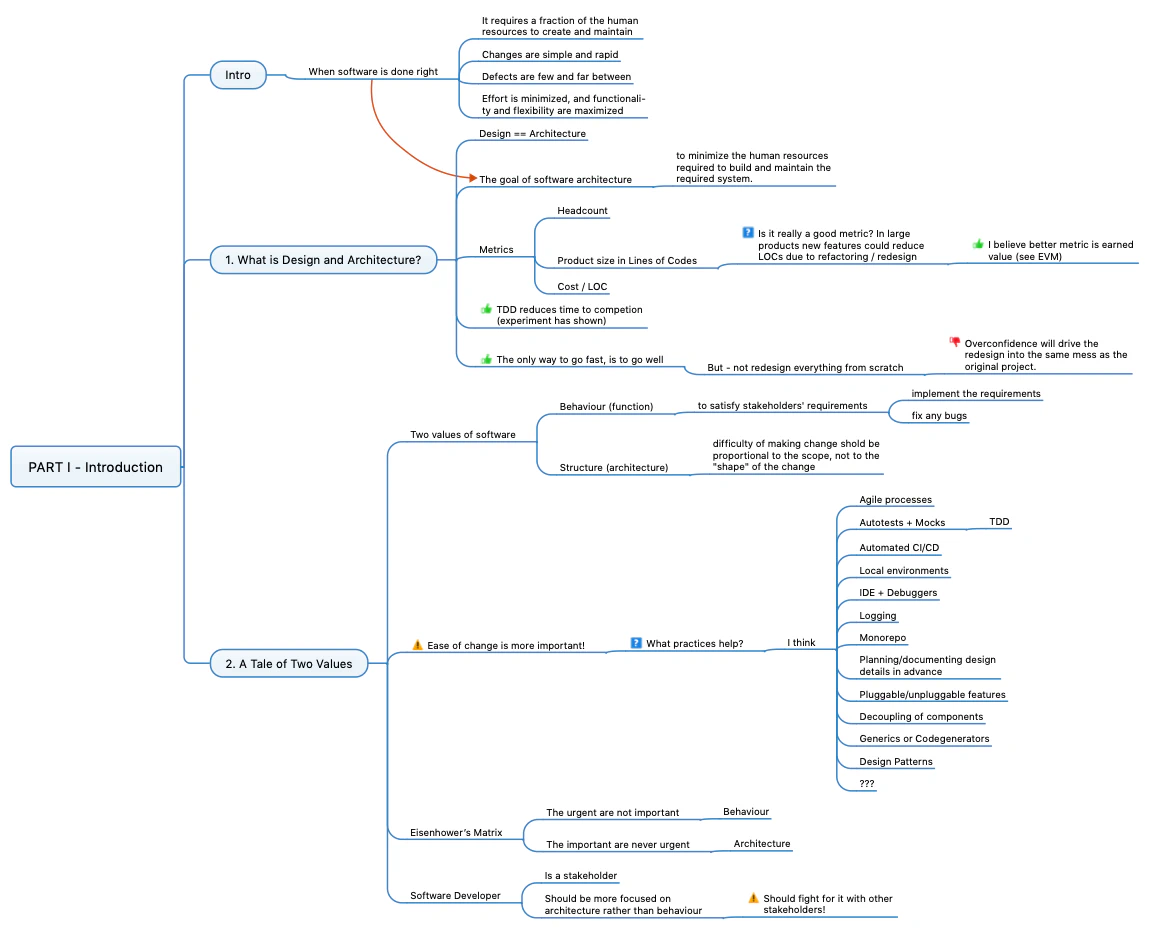
Here’s an overview of the first part:

  • The goal of software architecture
    • to minimize the human resources required to build and maintain the required system.
  • Two values of software
    • Behaviour (function) - to satisfy stakeholders’ requirements
    • Structure (architecture) - difficulty of making change should be proportional to the scope, not to the “shape” of the change
  • Ease of change is more important!
    • Software Developer should fight 🤺 for it with other stakeholders!
Part I - Introduction

Download full mind map (PDF)