Stream Processing

Designing Data-Intensive Applications - Chapter 12 - The Future of Data Systems

Designing Data-Intensive Applications - Chapter 12 - The Future of Data Systems

Translations: RU

Earlier the book club of our company has studied excellent book:

Martin Kleppmann - Designing Data-Intensive Applications

This is the best book I have read about building complex scalable software systems. ๐Ÿ’ช

As usually I prepared an overview and mind-map.

Chapter 12 is a summary of the book and a visionary view of the future.

  • Data Integration.
    • Overview of the ways we have to integrate data.
    • Causality and why we need Total Order and Idempotency.
    • Transactions and Linearizability
    • Limitations of Total Order.
    • Lambda architecture and unifying batch and stream processing as the most perspective approach.
  • Unbundling Databases.
    • Overview of composing data storages together.
    • Designing apps around Dataflow.
    • Usage of derived states.
  • Aiming for Correctness: what problems to consider and how to deal with them.
    • End-to-end fencing token.
    • How to process multi-partition requests.
    • Timeliness and Integrity issues. Apology workflow in business.
    • Meta approach: Trust, but Verify.
  • Doing the Right Thing.
    • Predictive Analytics is discriminating people! We have responsibility and accountability here.
    • Privacy is conflicting with Tracking. Total surveillance should be legislated and self-regulated.
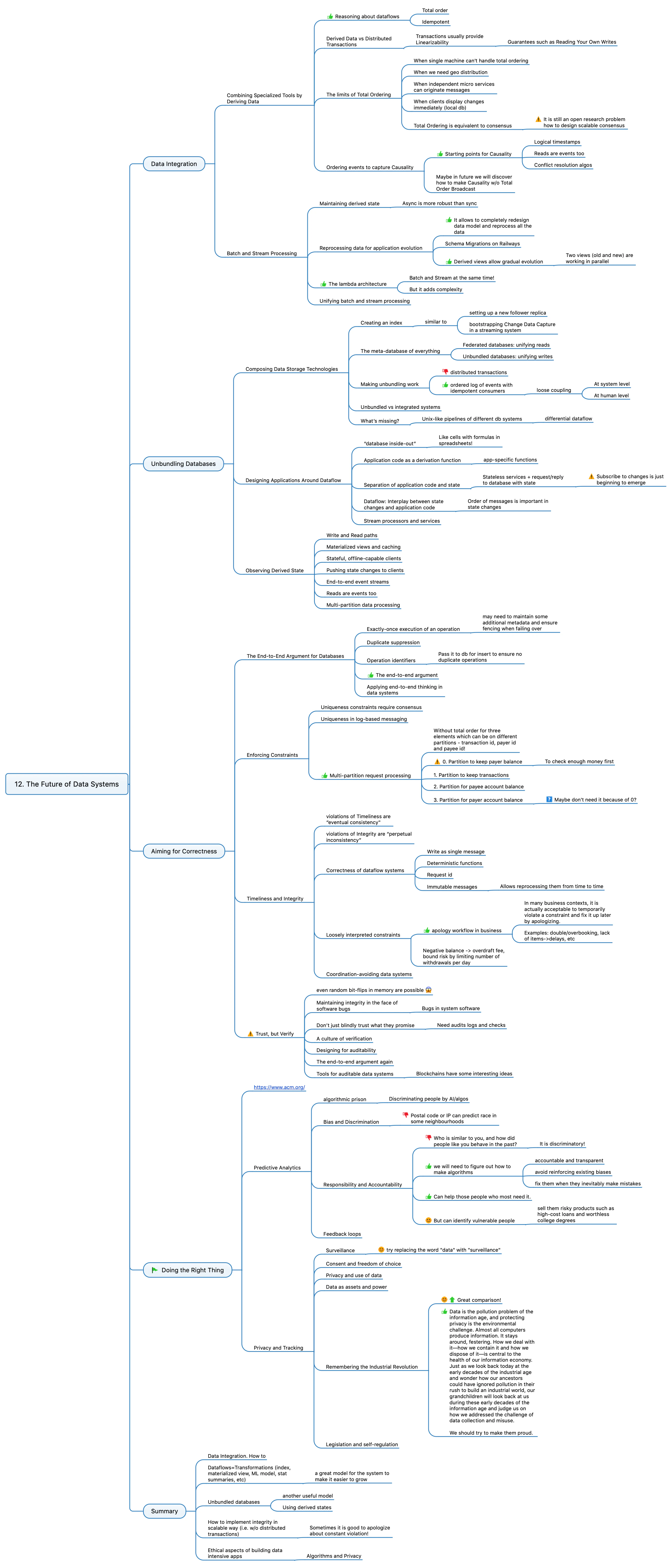
Download full mind map (PDF)

Designing Data-Intensive Applications - Chapter 11 - Stream Processing

Designing Data-Intensive Applications - Chapter 11 - Stream Processing

Translations: RU

Earlier the book club of our company has studied excellent book:

Martin Kleppmann - Designing Data-Intensive Applications

This is the best book I have read about building complex scalable software systems. ๐Ÿ’ช

As usually I prepared an overview and mind-map.

Chapter 11 discovers all aspects about Stream Processing. If your system needs to process some data on-the-fly then your DEV team should learn this info.

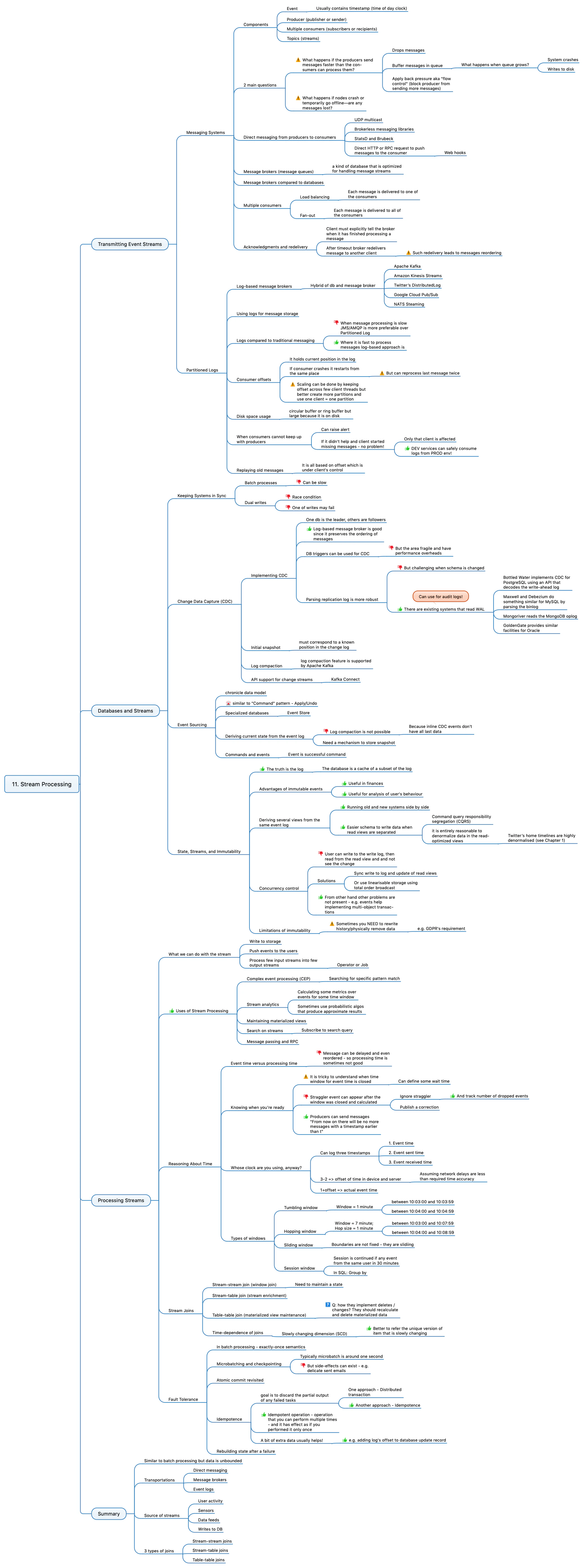
  • Approaches for transmitting events: Direct messaging, Messaging Systems and Partitioned Logs. Their implementations, pros and cons.
  • How to use Streams for databases. Sync databases, Change Data Capture (CDC), Event Sourcing. State, Streams, and Immutability.
  • Nuances of Processing Streams. Useful use cases, reasoning about Time, 3 types of stream Joins, Fault Tolerance.

Download full mind map (PDF)

Designing Data-Intensive Applications - Chapter 1 - Reliable, Scalable, and Maintainable Applications

Designing Data-Intensive Applications - Chapter 1 - Reliable, Scalable, and Maintainable Applications

Translations: RU

Earlier this year the book club of our company has studied excellent book:

Martin Kleppmann - Designing Data-Intensive Applications

This is the best book I have read about building complex scalable software systems. ๐Ÿ’ช

As usually (to better learn) I prepared an overview and mind-map.

Chapter 1:

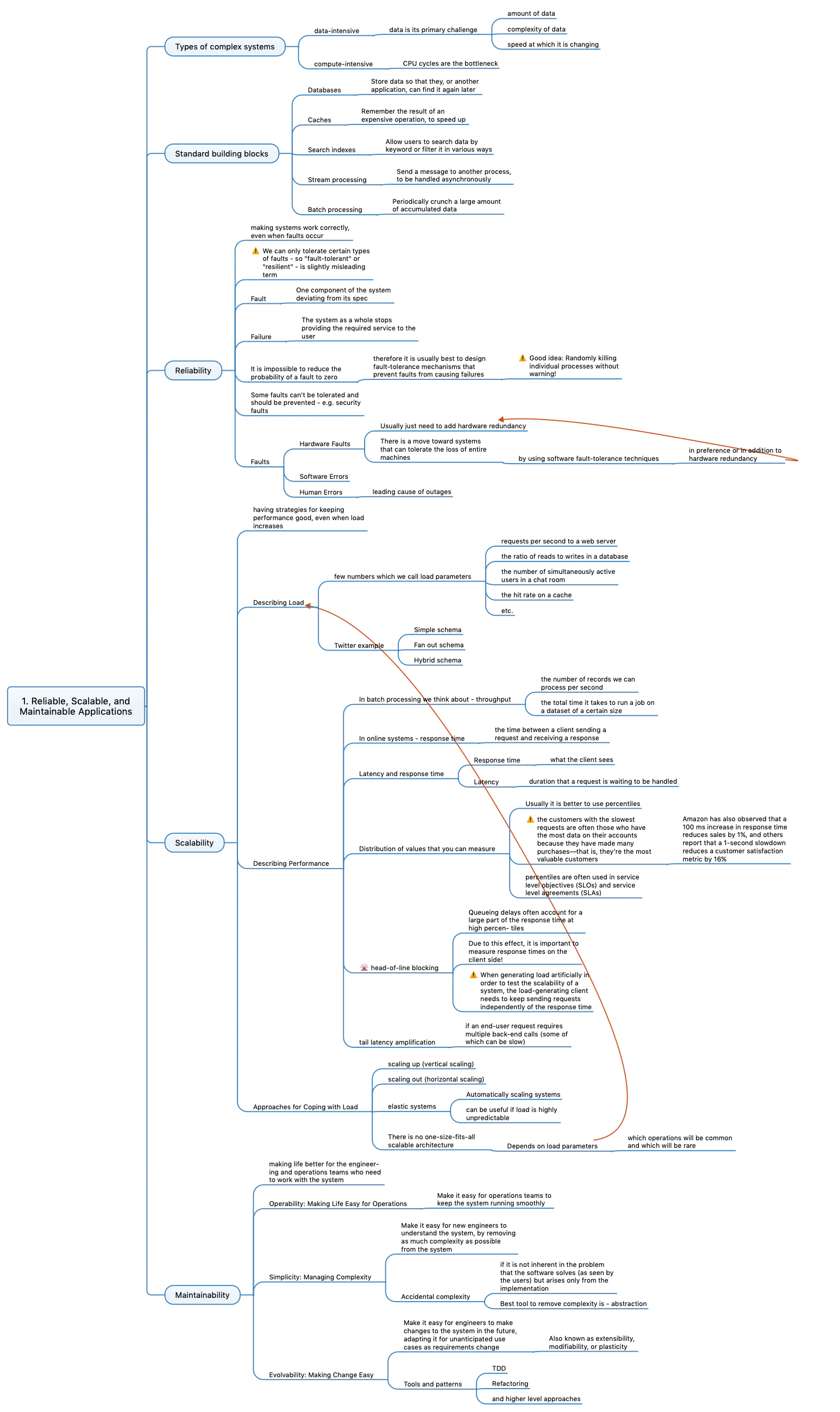
  • Building blocks of the apps
  • What is Reliability, Scalability and Maintainability. Examples and definitions.
    • Faults and Failures
    • Performance, Load, Latency and Response Time
    • Operability, Simplicity, Evolvability
  • Why you should randomly kill your servers ๐Ÿ˜…
  • How Twitter delivers 12,000 tweets per second to 300,000 readers per second. (VERY interesting!)
  • How much money Amazon loses for each 100ms delay in their response time
  • How to quickly calculate percentiles for monitoring response time in PROD

Download full mind map (PDF)