
Event Sourcing

Building Event-Driven Microservices - Chapter 4 - Integrating Event Driven Architectures with Existing Systems

Building Event-Driven Microservices - Chapter 4 - Integrating Event Driven Architectures with Existing Systems

Translations: RU

Data Liberation is the process of moving from monolith towards microservices by decoupling systems in terms of data dependencies.

There are three patterns for Data Liberation:

  1. Query-based
  2. Log-based
  3. Table-base

Each pattern has its own pros and cons, as well as other important considerations.

Data definition changes (data structure migrations) must also be supported by the chosen Data Liberation approach.

There are different Liberation frameworks/tools that simplify the process of Data Liberation. Note, that the CDC tools are not the final destination but just a boot-strap for the process.
Designing Data-Intensive Applications - Chapter 11 - Stream Processing

Designing Data-Intensive Applications - Chapter 11 - Stream Processing

Translations: RU

Earlier the book club of our company has studied excellent book:

Martin Kleppmann - Designing Data-Intensive Applications

This is the best book I have read about building complex scalable software systems. 💪

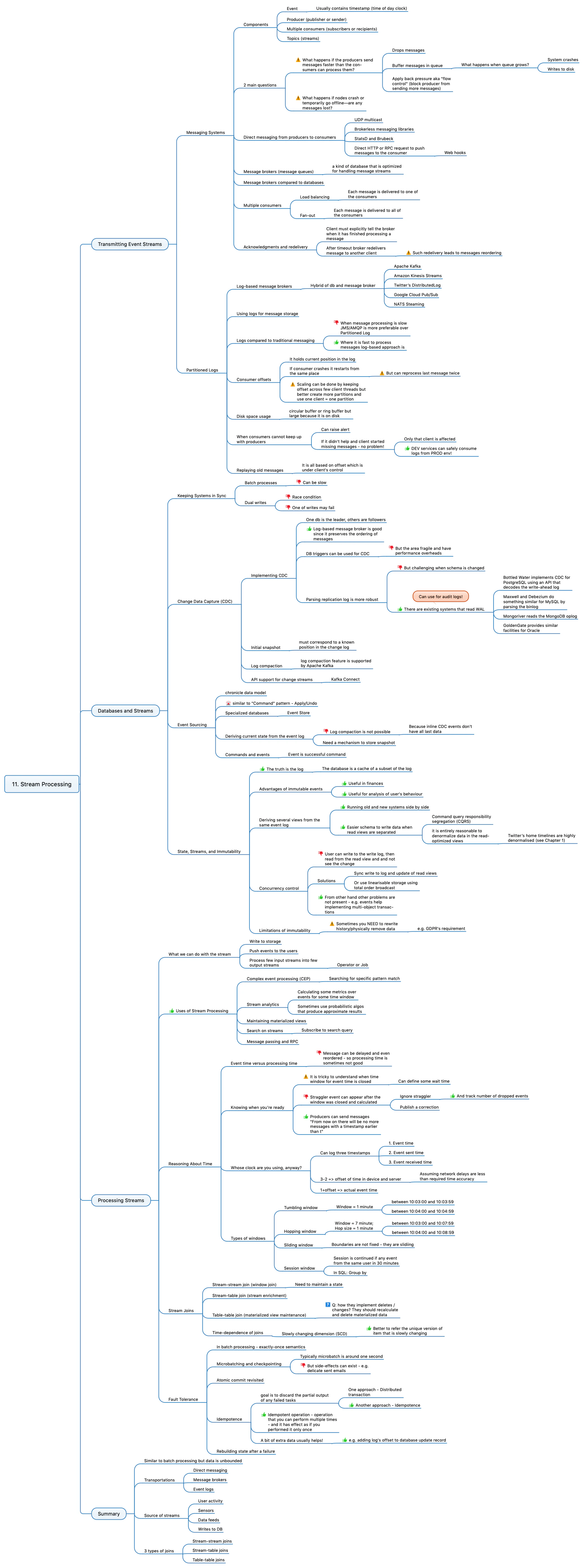
As usually I prepared an overview and mind-map.

Chapter 11 discovers all aspects about Stream Processing. If your system needs to process some data on-the-fly then your DEV team should learn this info.

  • Approaches for transmitting events: Direct messaging, Messaging Systems and Partitioned Logs. Their implementations, pros and cons.
  • How to use Streams for databases. Sync databases, Change Data Capture (CDC), Event Sourcing. State, Streams, and Immutability.
  • Nuances of Processing Streams. Useful use cases, reasoning about Time, 3 types of stream Joins, Fault Tolerance.

Download full mind map (PDF)