Failures

Building Event-Driven Microservices - Chapter 5 - Event-Driven Processing Basics

Building Event-Driven Microservices - Chapter 5 - Event-Driven Processing Basics

Translations: RU

Overviewing basics of event processing in Event-Driven Architectures:

  • Typical structure of microservice
  • Typical types of event transformations, 2 branching scenarios, merging streams
  • Repartitioning events and when it can be useful
  • Copartitioning events and when it is needed
  • Assigning Partitions to a Consumer Instance. Three strategies to do this.
  • Recovering from stateless processing instance failures.

These topics are disclosed in the Chapter 5 of the book we are currently studying:

“Building Event-Driven Microservices: Leveraging Organizational Data at Scale” by Adam Bellemare
Designing Data-Intensive Applications - Chapter 8 - The Trouble with Distributed Systems

Designing Data-Intensive Applications - Chapter 8 - The Trouble with Distributed Systems

Translations: RU

Earlier the book club of our company has studied excellent book:

Martin Kleppmann - Designing Data-Intensive Applications

This is the best book I have read about building complex scalable software systems. 💪

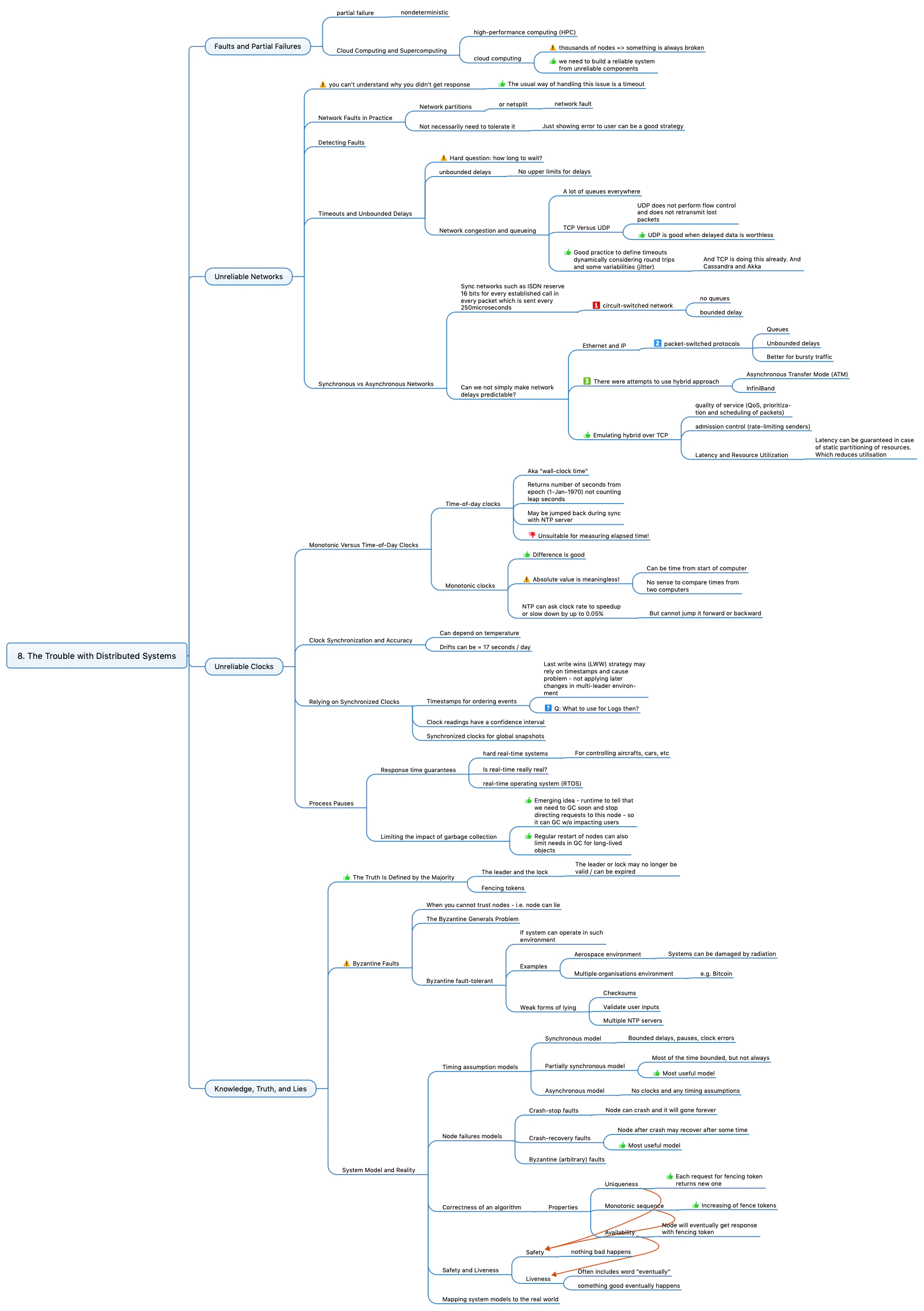
As usually I prepared an overview and mind-map.

Chapter 8 discovers non-database related problems of distributed systems. DEV teams should consider them when designing distributed software.

  • Faults and Partial Failures. The need to build a reliable system from unreliable components.
  • Problem 1: Unreliable Networks. Why they happen. How to detect them. How to deal with them. Synchronous and Asynchronous networks. Hybrid networks and emulating hybrid networks.
  • Problem 2: Unreliable Clocks. Monotonic Clocks vs Time-of-Day Clocks. What to use and what not to use in different cases. Good practices.
  • Problem 3: Knowledge, Truth, and Lies. What is Truth in distributed systems. The Byzantine Generals Problem. System Model and Reality: what to use for what cases.

Download full mind map (PDF)